Most SSH clients make you choose: a terminal that cannot move files, or a
file manager that cannot give you a shell. And none of them speak to the USB-serial
adapter on your desk.
macOS 13+ · Apple silicon and Intel · Notarized by Apple · Not on the Mac App Store
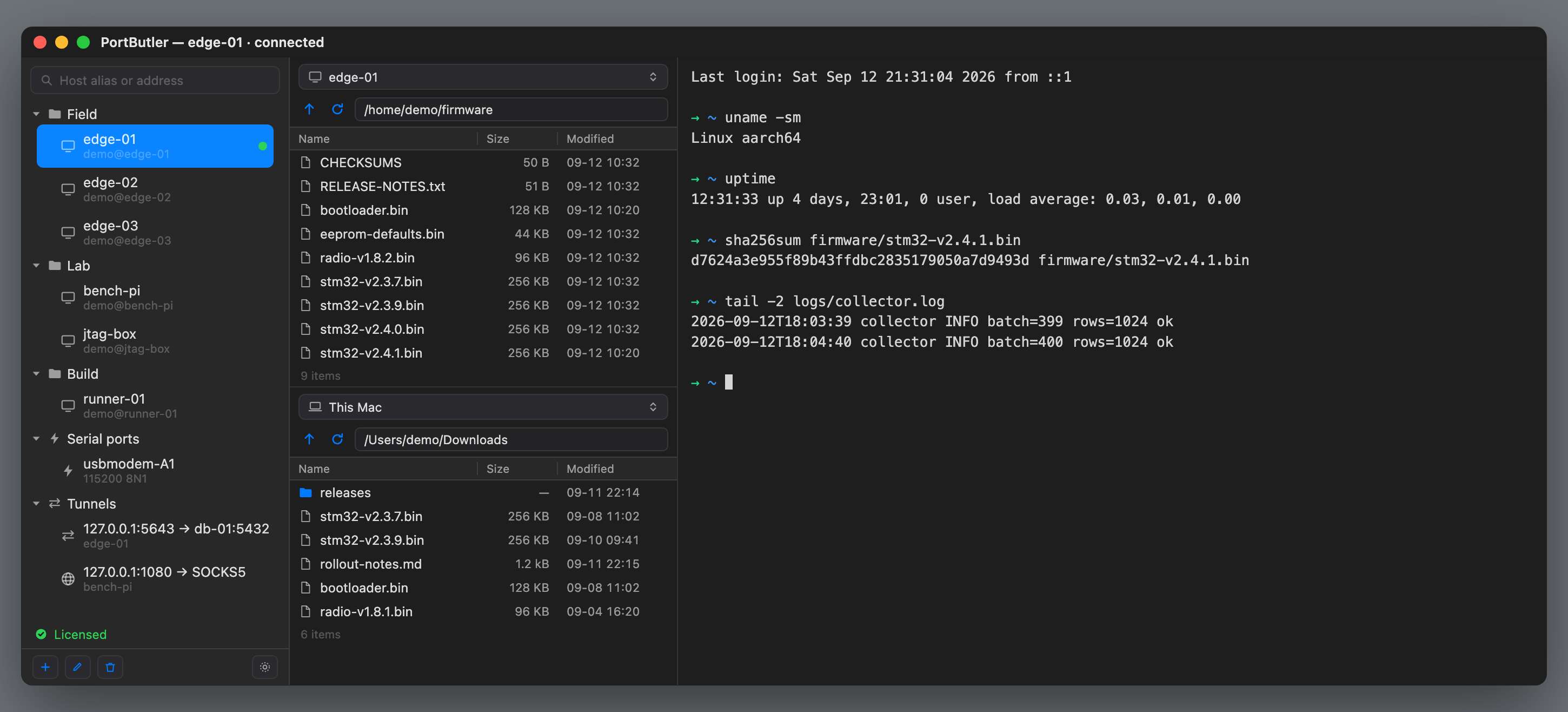
Pick a host on the left and it opens as a tab in this window.
Five machines means five tabs — not five windows.
Measured, not quoted
108 MB/s, where scp gets 74.
Same Mac, same server, same 64 MB file. The reason is not micro-optimisation — it is the
shape of the transfer. scp waits for each 32 KiB chunk to be acknowledged
before asking for the next. PortButler keeps four streams in flight and writes each
256 KiB chunk in place.
Raspberry Pi 5 over 1GbE
Same machine (no wire limit)
PortButler
108 MB/s
465 MB/s
scp
74 MB/s
267 MB/s
sftp
74 MB/s
267 MB/s
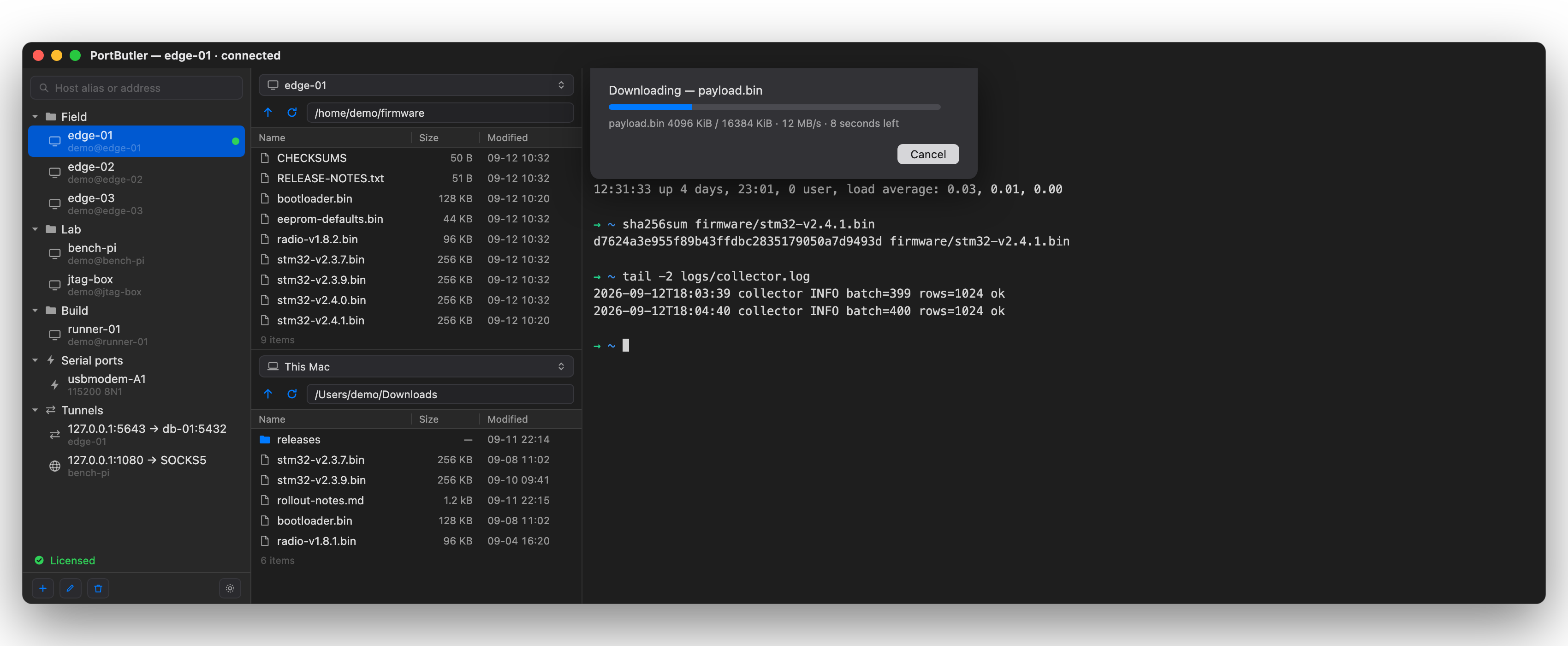
The number is on screen while it runs. Megabytes per second and the time
left, in the same units as the table — so you are not asked to take this page's word for it.
That 108 MB/s is 91% of the theoretical maximum of a gigabit wire. There is no room left
to win on that cable, which is why the same-machine column exists. Every number here was
measured on one Mac, and the method is published —
BENCHMARK(Korean).
When it goes wrong
It tells you why it failed.
connection failed is not an error message. These five look identical on most
clients and each needs a completely different fix.
What happened
What PortButler tells you
The port refused it
The machine is up. Check the port — many devices use 2222
Nothing answered
Powered off, or a firewall dropping packets silently
The name will not resolve
Check spelling, or whether it only exists on a VPN
Connected, no SSH greeting
That port is not SSH, or sshd is stuck
Something answered, not SSH
A web server may be sitting on that port
Built for fleets
Five thousand boards, one password.
That is what an embedded rollout looks like: the same account and the same password on
every unit. Save it once as a credential and type an address — the login
comes from there. Change the password later and every machine follows, because they point
at the credential, not a copy of it.
The password never appears
The list shows names and accounts. The password lives in this Mac's Keychain, is read
the instant you press Return, and goes straight to the session — it is not rendered,
and it never leaves this device.
It will not lock you out
Servers count failed logins. Most clients offer every key in your agent and get cut off
before you are ever asked for a password. PortButler offers at most four,
so an attempt is always left — and when the credential says password, it offers none.
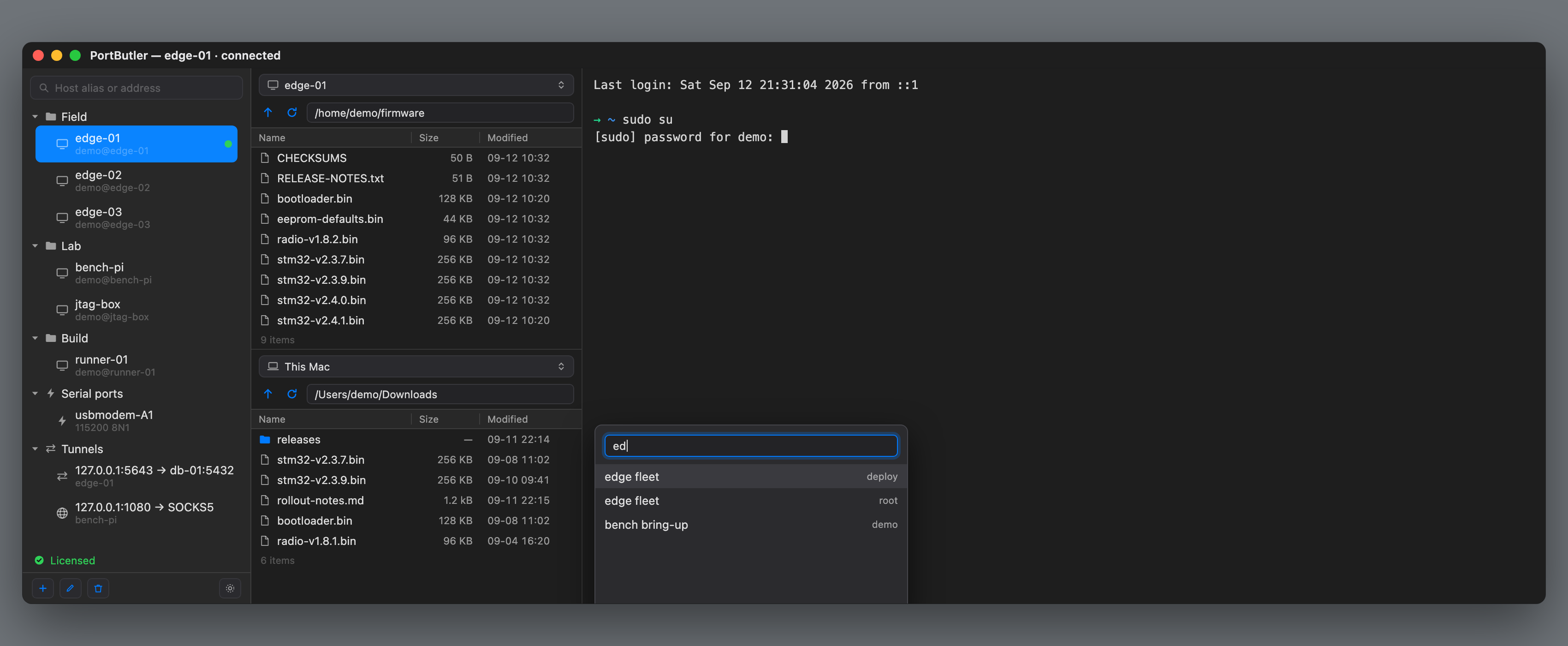
A password prompt appears, the list opens over it, type to filter, Return to send.
Before you buy
What it does not do.
Listed first, because you will find out anyway and it is better you find out here.
PortButler
Where it exists
Saved command snippets
Not yet
Termius, WindTerm
Folder transfer, resume, queue
Not yet
Transmit, ForkLift
Same input to many sessions
Not yet
SecureCRT, iTerm
Split panes
Tabs only
iTerm, WindTerm
Serial in the same window
Yes
No SSH client does this
It reads ~/.ssh/known_hosts and uses ssh-agent and the keys you
already have. It imports ~/.ssh/config when you ask it to, and
never writes to that file.
Pricing
Try it for 14 days.
$29one-time · not a subscription
When the trial ends it stops connecting — your session list stays.
Major upgrades are $15. A ten-seat pack is $240.
macOS 13+ · Apple silicon and Intel · Notarized · Direct download, not the Mac App Store
Something not working, or missing?
Open an issue — it is read by the person who wrote the code.
The app has Help → Report an Issue… too, which fills in your macOS and app version.
 PortButler